
- English
- Español
- Português
- русский
- Français
- 日本語
- Deutsch
- tiếng Việt
- Italiano
- Nederlands
- ภาษาไทย
- Polski
- 한국어
- Svenska
- magyar
- Malay
- বাংলা ভাষার
- Dansk
- Suomi
- हिन्दी
- Pilipino
- Türkçe
- Gaeilge
- العربية
- Indonesia
- Norsk
- تمل
- český
- ελληνικά
- український
- Javanese
- فارسی
- தமிழ்
- తెలుగు
- नेपाली
- Burmese
- български
- ລາວ
- Latine
- Қазақша
- Euskal
- Azərbaycan
- Slovenský jazyk
- Македонски
- Lietuvos
- Eesti Keel
- Română
- Slovenski
- मराठी
- Srpski језик
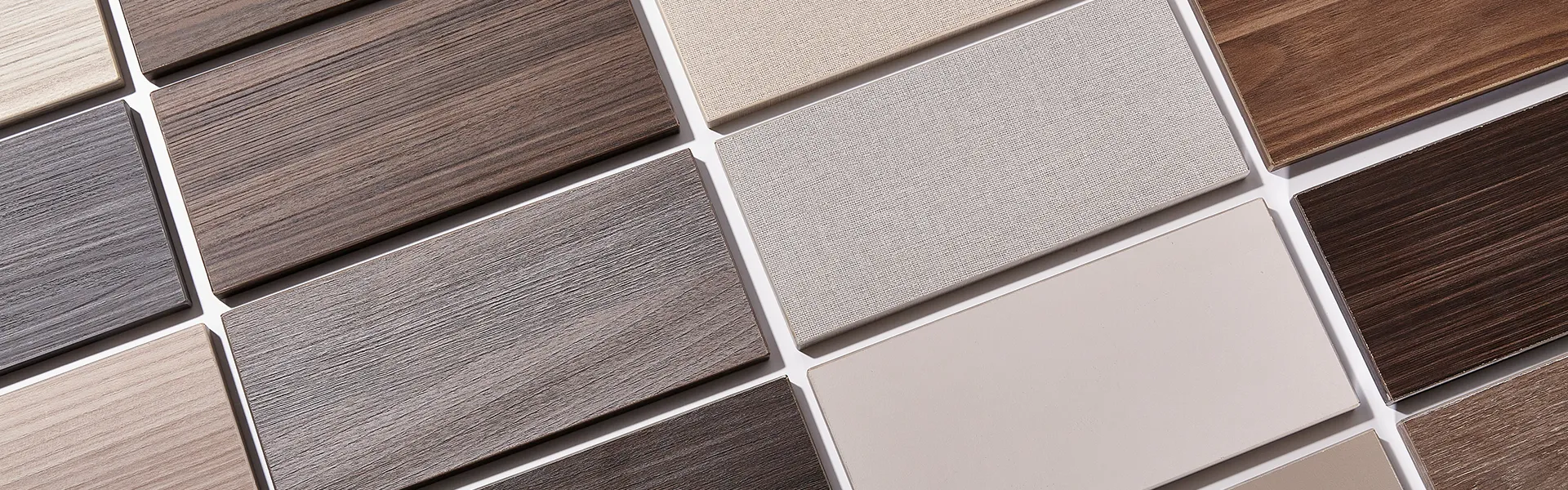
PET, PVC and Acrylic Veneer Comparison
PVC, PET and acrylic veneers are all mainstream thermoplastic decorative films, widely laminated on substrate materials including MDF, particle board and HMR board. Among them, PVC veneer is predominantly used for vacuum forming processes, while PET and acrylic veneers are mainly applied to flat high-gloss cabinet door panels. This article conducts a comprehensive comparison of the three materials in terms of specifications, performance, advantages, disadvantages and application scenarios to provide professional material selection guidance.
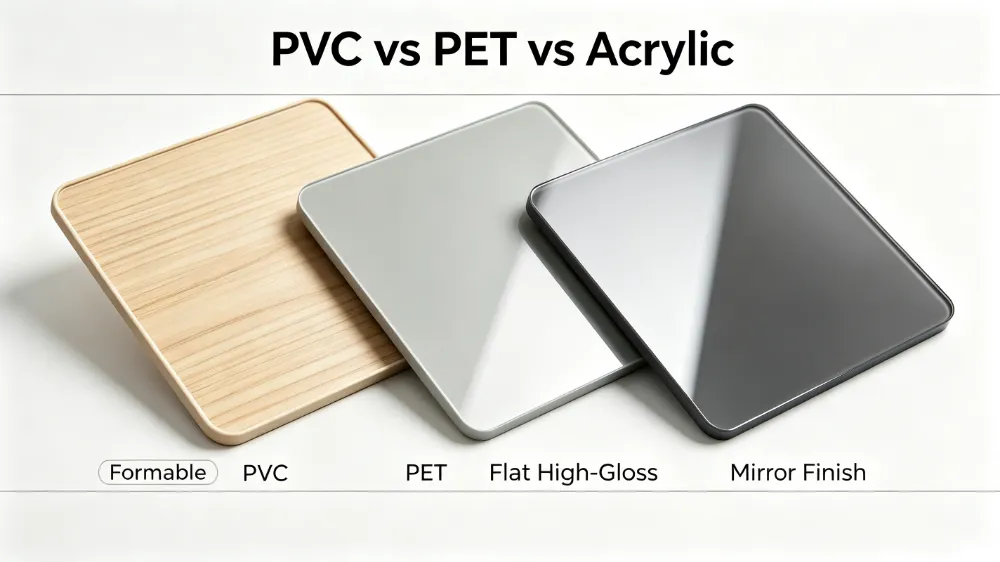
1. PVC Veneer / Vacuum Forming Film
Thickness: 0.12-0.6 mm. It is the most commonly used decorative material for vacuum-formed MDF doors.
Core Advantages
• Excellent formability: Adaptable to curved surfaces, routed profiles and 3D vacuum wrapping processes, delivering molding effects that cannot be easily achieved by PET and acrylic veneers.
• Cost-effective with rich patterns: Low raw material cost, with diverse surface textures including wood grain, solid color, leather texture and stone grain to meet diverse decorative styles.
• Mature and compatible process: The lamination technology is mature and stable, compatible with both EVA and PUR adhesives, with low processing threshold and high yield.
Main Disadvantages
• Poor weather resistance: Weak UV resistance and anti-yellowing performance. It is prone to discoloration under long-term sunlight exposure. The material softens at 60-85°C, and is likely to have plasticizer migration, shrinkage and edge lifting problems in high-temperature and high-humidity environments.
• General physical performance & market restrictions: Standard products have ordinary scratch resistance. Due to chlorine content, PVC veneers are subject to usage restrictions in some EU and Australian export markets.
• Average chemical resistance: The surface is vulnerable to damage from part of daily chemical cleaners, limiting its service durability.
Application Scenarios: Mainly used for indoor vacuum-formed cabinet doors. Not applicable for sun-exposed spaces and outdoor environments.
2. PET Veneer (GAG Co-extruded: PETG + APET)
Thickness: 0.3-0.5 mm. It is a high-grade decorative material for flat panels, supporting high-gloss and matte soft-touch surface finishes, and not suitable for deep profiling molding.
Core Advantages
• Superior weather and heat resistance: Excellent anti-yellowing and UV resistance, far surpassing PVC veneers. The heat resistance temperature can reach about 120°C, with strong resistance to daily household chemicals and cleaners.
• Environmentally friendly and export-compliant: Plasticizer-free and halogen-free, recyclable and eco-friendly, fully meeting the environmental standards of EU, Australia and New Zealand markets.
• Good decorative and bonding performance: It can present a delicate mirror high-gloss effect and comfortable soft-touch matte texture. It has strong bonding force with PUR adhesive, low delamination risk, and less edge chipping during trimming compared with acrylic veneers.
• Stable dimensional performance: Excellent structural stability, effectively avoiding edge warping problems caused by high temperature in container sea transportation, with better transportation adaptability than PVC.
Main Disadvantages
• Poor flexibility: Far less flexible than PVC veneers. It can only be used for flat panels and shallow radius corners, and cannot realize deep routing and complex 3D special-shaped molding.
• Surface and cost limitations: Ordinary high-gloss PET surfaces are easy to leave fingerprints; high-grade anti-fingerprint PET materials will increase overall procurement costs.
• High processing requirements: Specialized processing equipment and professional PUR adhesive are required. Non-standard construction is easy to cause surface defects such as orange peel and wavy lines.
Application Scenarios: Flat high-gloss doors, soft-touch decorative doors and wall panels. Ideal for indoor furniture export projects in Australia, New Zealand, the Middle East and other regions.
3. Acrylic Veneer (PMMA)
Thickness: 0.8-1.2 mm. Different from flexible film materials, it is a rigid solid sheet, which can only be applied to flat panels through hot-press lamination process.
Core Advantages
• Top-grade surface performance: It has the highest surface hardness among the three materials, with mirror-like gloss finish comparable to paint finishing, and outstanding UV resistance and anti-yellowing ability.
• Strong stain and chemical resistance: The surface is dense and smooth, not easy to adhere to stains, easy to clean and maintain, and resistant to most conventional chemicals.
Main Disadvantages
• Brittle and difficult to process: The material is brittle, prone to serious edge chipping during CNC cutting and edge trimming. It has almost no bending performance, only suitable for flat panels with ultra-small bending radius, resulting in low production yield and high processing cost.
• High cost and poor stability under variable temperature and humidity: It has the highest raw material cost among the three veneers. Its large thermal expansion coefficient makes large-size panels easy to bulge under alternating temperature and humidity environments.
• Poor impact resistance: The high-gloss surface is easy to leave fingerprints, and the sheet is vulnerable to cracking under strong external impact.
Application Scenarios: High-end minimalist flat high-gloss cabinet doors. Not applicable for special-shaped profiled panels and large-size thin substrates.
Comprehensive Performance Comparison Table
| Comparison Item | PVC Veneer | PET (GAG) Veneer | Acrylic (PMMA) Veneer |
|---|---|---|---|
| Formability | ⭐⭐⭐⭐⭐ Deep-draw vacuum forming, suitable for 3D special-shaped surfaces | ⭐⭐ Only for flat panels and shallow radius corners | ⭐ Only for flat panels, hardly bendable |
| UV-resistance & Anti-yellowing | ⭐⭐ General performance, easy to discolor | ⭐⭐⭐⭐ Excellent performance | ⭐⭐⭐⭐⭐ Top-grade performance |
| Heat Resistance | Poor (Softens below 85°C) | Good (Resistant up to 120°C) | Good |
| Surface Hardness | Low-Medium | Medium-High | Highest |
| Export Environmental Compliance | Limited in partial markets (contains chlorine) | Fully compliant with EU/AU/NZ standards | Good compliance |
| Processing Difficulty | Low, suitable for vacuum forming | Medium, requires professional PUR flat lamination | High, high chipping risk and low yield |
| Material Cost | Lowest | Medium-High | Highest |
| Typical Thickness | 0.15-0.6 mm | 0.3-0.5 mm | 0.8-1.2 mm (rigid sheet) |
| Main Processing Technology | Vacuum forming / vacuum wrapping | PUR hot flat lamination | Hot-press rigid sheet lamination |
Professional Material Selection Guide
1. For profiled/routed special-shaped cabinet doors: Select PVC vacuum forming veneer. Avoid using in long-term sun-exposed environments to prevent discoloration and deformation.
2. For export furniture projects (Australia, New Zealand, Middle East): Prioritize PET veneer for flat high-gloss and soft-touch finished products. It balances anti-yellowing performance and cost, and matches PUR edge-banding technology to ensure stable quality during sea transportation.
3. For high-end mirror-grade decorative requirements with sufficient budget: Choose acrylic veneer, which is suitable for small-size flat high-gloss cabinet doors. Strict cutting and processing control is required to reduce edge chipping defects.
4. For outdoor usage scenarios: None of the above three veneers are applicable for long-term outdoor exposure (all are indoor-only materials). WPC material is recommended for outdoor decorative substrates.
Important Notes
The market has PET-on-PVC composite films (PVC base + thin PET top layer). Although this composite material is low in cost, the PVC base layer still has hidden risks of shrinkage and delamination in high-temperature container environments during sea transportation. It is necessary to strictly distinguish it from genuine GAG co-extruded PET veneer to avoid project quality problems.
 Hanhua
 Jake lin